

Investigating Snap-8 10mg in Neuromuscular Signaling Models
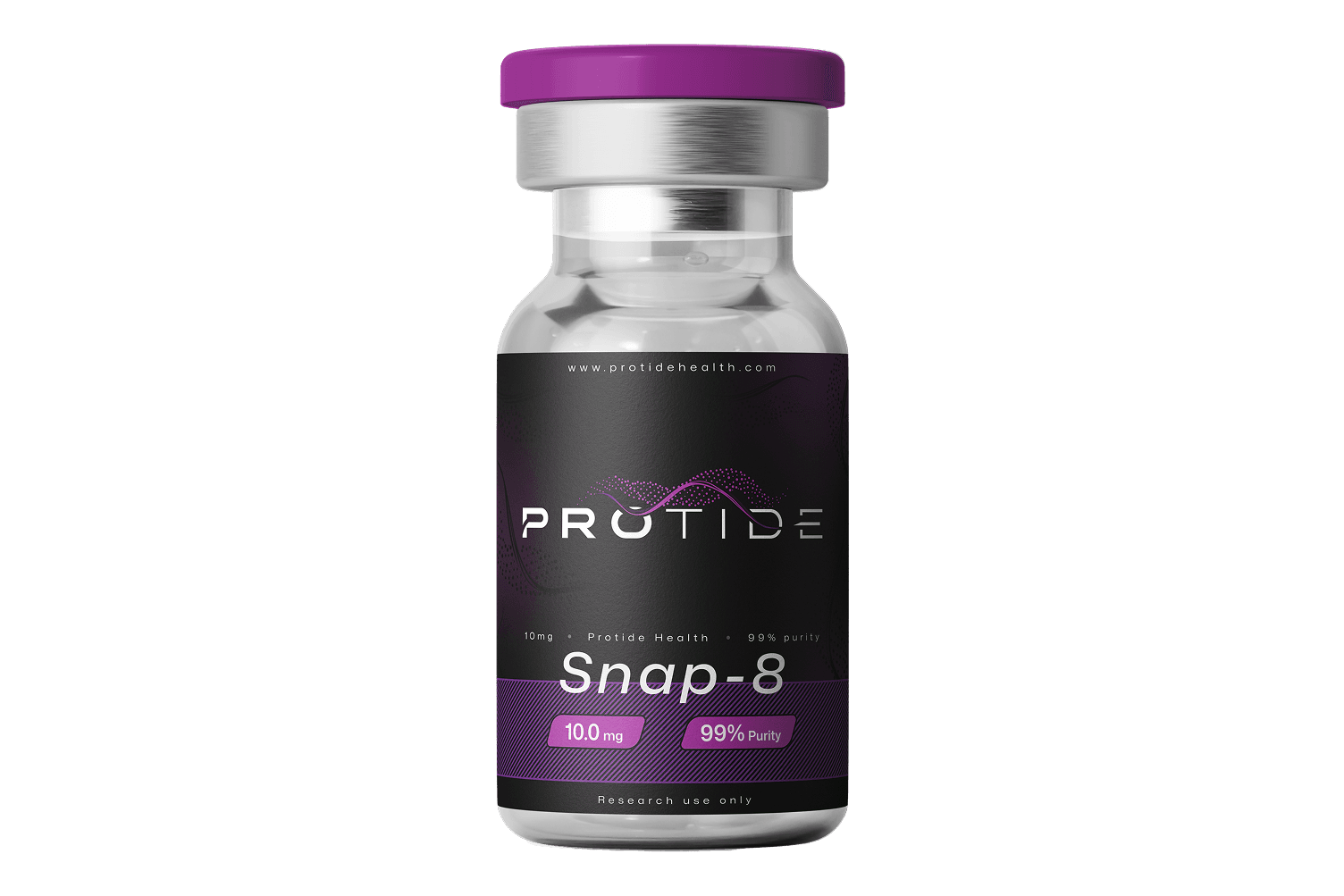
Snap-8 10mg (Acetyl Octapeptide-3) is a synthetic octapeptide currently under extensive laboratory investigation. Researchers examine this compound in preclinical models to understand its interaction with protein complexes that drive neuromuscular signaling pathways. This article explores current in vitro data and delivery mechanisms associated with this sequence.
Molecular Structure of Snap-8 10mg
In vitro studies analyze the specific structural properties of this synthetic sequence. Research investigates its derivation from the N-terminal portion of SNAP-25, measuring how it influences cellular signaling environments.
Composition and SNARE Complex Binding
The sequence Ac-Glu-Glu-Met-Gln-Arg-Arg-Ala-Asp-NH₂ is designed for laboratory investigation into protein-protein interactions (MDPI). Researchers examine how it interferes with SNARE complex assembly, an essential cellular mechanism.
Studies investigate:
-
Calcium-triggered synaptic vesicle fusion metrics
-
Acetylcholine release inhibition in cellular assays (PubMed)
-
Competitive binding mechanisms in isolated neural models
Delivery Mechanisms in Preclinical Models
Experimental applications focus heavily on overcoming cellular barriers. In vitro models measure the permeability of this octapeptide through stratum corneum equivalents (simulated outer cellular layers).
Formulations and Permeability Metrics
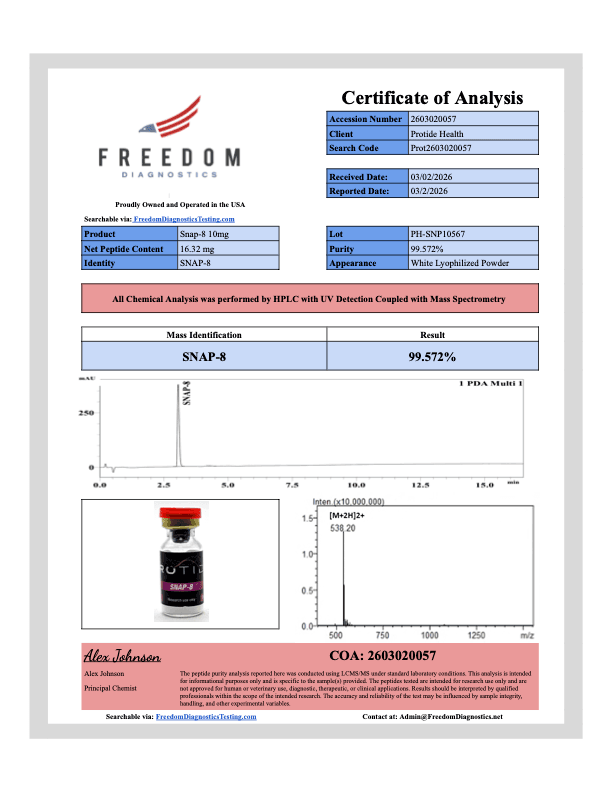
Laboratory investigation frequently utilizes dissolving hyaluronic acid arrays to ferry hydrophilic peptides across complex lipid barriers (PubMed). Liquid chromatography-mass spectrometry (LC-MS/MS) methods quantify these delivery rates in controlled settings (Springer).
Observations in these models include:
-
Validation of peptide identity and content uniformity
-
Measurement of transient microchannel permeability
-
Structural integrity of the peptide in complex tissue matrices
For broader insight into formulating laboratory models, review our peptide guides.
Investigating Dermal and Structural Pathways
While predecessor molecules like AH-8 have been studied in various contexts, current research on this specific octapeptide remains strictly confined to in vitro mechanism evaluation. Animal studies assess localized tissue responses following simulated neurotransmitter modulation.
Measuring Structural Protein Metrics
Researchers utilize high-resolution imaging and cutometry (elasticity measurement) on isolated tissue equivalents to observe neuromuscular modulation (PubMed). Studies examine how altering neurotransmitter release impacts structural tension in adjacent tissues. Human evidence is absent, and these applications remain strictly experimental.
Comparing Snap-8 to Related Peptides
Researchers often analyze structurally related synthetic compounds to map variations in binding affinity and molecular weight across experimental models.
Frequently Asked Questions (FAQ)
What is Snap-8 investigated for?
Research examines its interaction with the SNARE complex in neuromuscular signaling pathways. Animal studies and isolated tissue models measure its ability to modulate acetylcholine release at the cellular level.
How are delivery models evaluated?
Preclinical models investigate structural permeability using matrix equivalents and transient microchannels. Researchers quantify peptide absorption through lipid barriers using validated analytical testing.
Conclusion on Snap-8 10mg Research
In conclusion, Snap-8 10mg remains a targeted subject of laboratory investigation regarding neuromuscular signaling and SNARE complex modulation. Preclinical models continue to explore its delivery mechanisms and structural permeability across lipid barriers.
References
-
Nguyen, T. T. M., et al. Cosmetics. MDPI
-
Rizo, J. Molecular Mechanisms Underlying Neurotransmitter Release. PubMed
-
Ji, M., et al. J Anal Sci Technol. Springer
-
Hong, J. Y., et al. J Cosmet Dermatol. PubMed
-
Liu, T., et al. Acta Pharm Sin B. PubMed
-
Aruan, R. R., et al. JCAD. JCAD
Legal Disclaimer
The information provided in this description is for research purposes only. The Snap-8 peptide is not approved by the U.S. Food and Drug Administration (FDA) or any regulatory authority for human consumption or therapeutic use. It is intended solely for investigational use in controlled laboratory settings by qualified researchers. Protide Health does not endorse or promote the use of Snap-8 peptide in humans or animals outside of approved research protocols. Researchers must comply with all applicable local, state, and federal regulations, including obtaining necessary approvals for experimental use. Consult with regulatory authorities before initiating any research involving Snap-8 peptide.
Products sold by Protide Health are for laboratory research purposes only and are not intended for human consumption, medical use, or veterinary use.
Be the first to review “Snap-8 10mg”
Related products
Dermatological Research
Cellular Longevity Research
Best Selling
Cellular Longevity Research
Cellular Longevity Research
Cellular Longevity Research
Cellular Longevity Research
Best Selling
Reviews
There are no reviews yet.