

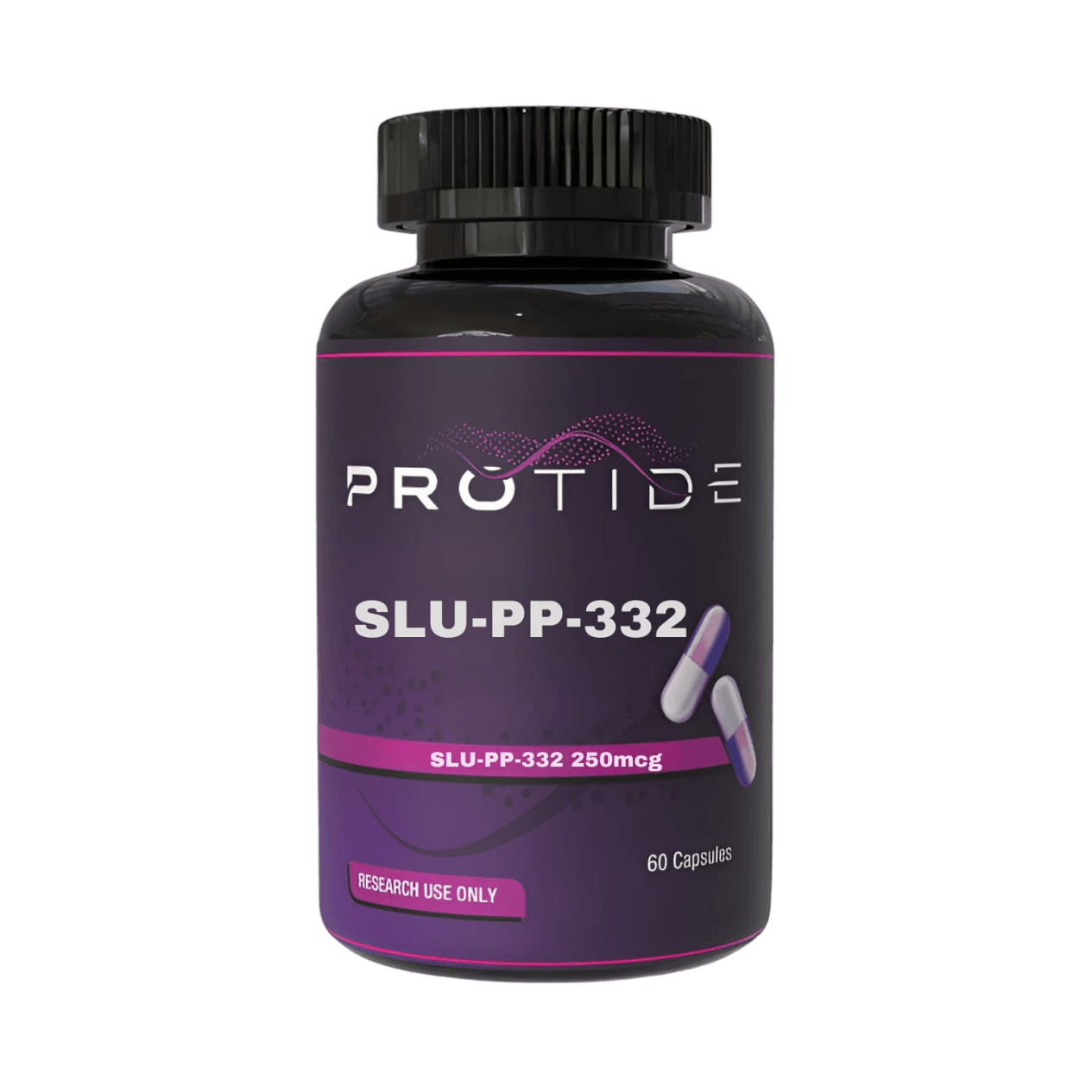
SLU-PP-332

$85.00
SLU-PP-332 Research Capsules. SLU-PP-332 is a synthetic estrogen-related receptor (ERR) agonist. Extensively investigated in preclinical and in-vitro models to observe signaling pathways related to mitochondrial function and metabolic cellular activity.
Format: 60 Capsules (250mcg per capsule)
Notice: This product is strictly for research purposes and is not intended for human consumption or clinical use.
Investigating SLU-PP-332 Research Capsules
SLU-PP-332 is a synthetic small molecule currently the subject of extensive laboratory investigation. Researchers examine this compound in preclinical models to map specific signaling pathways related to mitochondrial function and cellular metabolism. This article reviews current in vitro data and the molecular mechanisms of this research compound.
What is SLU-PP-332?
In vitro studies focus on how this synthetic molecule interacts with estrogen-related receptors (ERRs). Despite the name, these are “orphan” nuclear receptors that modulate how cells produce energy and synthesize mitochondria.
Formulation and Receptor Interaction
Available in a format of 60 capsules (250mcg per capsule), this compound is designed for precise measurement in laboratory subject models or specific in vitro dissolution protocols. It targets all three ERR subtypes (ERRα, ERRβ, and ERRγ).
Laboratory investigation measures its strong binding affinity to ERRα, which is linked to skeletal muscle energy pathways. Explore our complete research peptides catalog for more laboratory materials.
Mechanism of Action
Researchers evaluate how the compound triggers specific genetic expressions within isolated muscle cells. Preclinical models examine its role in activating the DDIT4 gene, which controls downstream metabolic signaling (PubMed).
Studies investigate:
-
Mitochondrial respiration pathway metrics
-
Fatty acid oxidation rate changes
-
Cellular transitions from fast-twitch to type IIa oxidative muscle fibers
Investigating SLU-PP-332 in Animal Studies
Experimental applications strictly measure specific biomarkers during induced physiological states. Researchers utilize various subject models to map the full pharmacological profile of this synthetic molecule.
Endurance and Muscle Fiber Models
Animal studies measure endurance markers in C57BL/6 mice following administration. Researchers evaluate the compound’s influence on specific muscle fiber densities in the quadriceps. In vitro studies utilizing C2C12 skeletal muscle cells measure maximal cellular respiration and mitochondrial activity in controlled environments (PubMed).
Metabolic and Lipid Measurement Models
Laboratory investigation frequently employs diet-induced obese (DIO) and ob/ob mouse models. Researchers use these models to map complex lipid metabolism and systemic energy pathways (PubMed).
Observations in these models include:
-
Resting energy expenditure metrics
-
Fatty acid oxidation rates during varying circadian cycles
-
Lipid accumulation levels in isolated liver tissue
Cardiac and Cellular Stress Models
Preclinical models measure physiological responses in transaortic constriction (TAC) subjects, which simulate cardiac stress. Research examines how ERR activation influences specific metabolic pathways within heart tissue (Circulation).
Researchers measure:
-
Autophagy (cellular cleanup) activation in cardiomyocytes
-
E2F1 modulation and cellular cycle pathways
-
ERRγ-mediated signaling metrics in isolated tissue
Cellular Aging and Renal Models
Researchers evaluate ERR expression variations in aging subjects. Animal studies measure specific renal biomarkers following the administration of the compound in older subject models (PubMed). Measured metrics include albuminuria levels, podocyte density, and the concentration of inflammatory cytokines. For more on compound classifications, view our peptide categories.
Compound Specifications
Researchers often analyze structurally targeted molecules to map distinct nuclear receptor pathways compared to other synthetic compounds.
Frequently Asked Questions (FAQ)
What is SLU-PP-332 investigated for?
Research examines its interaction with estrogen-related receptors (ERRs) in controlled settings. Animal studies measure its influence on skeletal muscle metabolism, mitochondrial signaling, and cellular energy expenditure.
Is this compound a peptide?
No. It is a synthetic small molecule. However, it is frequently utilized alongside peptides in laboratory investigation regarding cellular metabolism and receptor signaling.
Conclusion on SLU-PP-332 Research
In conclusion, SLU-PP-332 remains a significant focus of laboratory investigation regarding cellular metabolism and nuclear receptor activation. Preclinical models continue to examine its interaction with ERR pathways, mitochondrial function, and systemic energy models.
References
-
Billon, C., et al. ACS Chemical Biology. PubMed
-
Billon, C., et al. Journal of Pharmacology and Experimental Therapeutics. PubMed
-
Xu, W., et al. Circulation. Circulation
-
Wang, X. X., et al. The American Journal of Pathology. PubMed
-
Nasri, H. Journal of Renal Endocrinology. Journal of Renal Endocrinology
Legal Disclaimer
The information provided in this description is for research purposes only. SLU-PP-332 is not approved by the U.S. Food and Drug Administration (FDA) or any regulatory authority for human consumption or therapeutic use. It is intended solely for investigational use in controlled laboratory settings by qualified researchers. Protide Health does not endorse or promote the use of SLU-PP-332 in humans or animals outside of approved research protocols. Researchers must comply with all applicable local, state, and federal regulations, including obtaining necessary approvals for experimental use. Consult with regulatory authorities before initiating any research involving SLU-PP-332.
Products sold by Protide Health are for laboratory research purposes only and are not intended for human consumption, medical use, or veterinary use.
Be the first to review “SLU-PP-332”
Related products
Gastrointestinal Research
Cellular Longevity Research
Gastrointestinal Research
Cellular Longevity Research
Cellular Longevity Research
Best Selling
Cellular Longevity Research
Metabolic Research
Reviews
There are no reviews yet.