

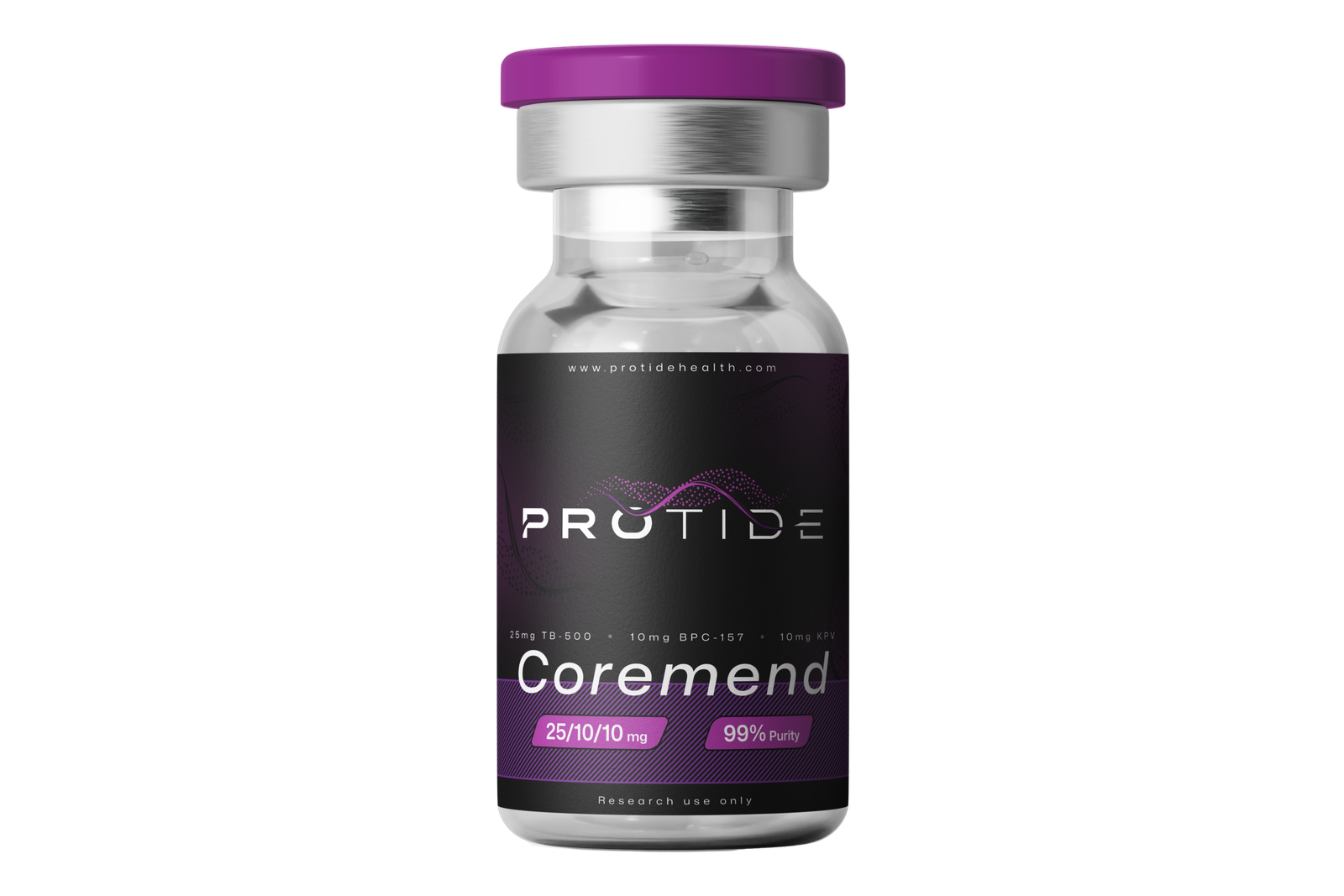
Coremend Blend (TB-500, BPC-157, KPV)
$225.00
Coremend is a multi-compound research formulation featuring TB-500 (25mg), BPC-157 (10mg), and KPV (10mg). Investigated in preclinical models of inflammatory resolution, angiogenesis, and structural tissue repair. Supplied as a stable lyophilized vial. Third-party HPLC-verified 99% purity. For research use only. Not for human consumption.
Coremend: A Three-Phase Tissue and Inflammatory Research Blend
Coremend is a specialized, multi-compound research formulation that combines TB-500 (25mg), BPC-157 (10mg), and KPV (10mg) into a single lyophilized vial. Designed for comprehensive tissue repair investigations, this blend allows researchers to model the complete biological recovery cycle within controlled environments. Scientists utilize Coremend to track molecular sequences from initial inflammatory regulation to structural regeneration.
Investigating the Three-Phase Repair Model
Research indicates that effective tissue regeneration follows a sequential biological cascade. Preclinical models utilize the Coremend blend to investigate how targeting different phases simultaneously alters the overall trajectory of cellular recovery.
Suppress, Supply, Rebuild Pathways
Coremend introduces a structured, three-axis approach to tissue research by integrating the anti-inflammatory properties of KPV with the established mechanisms of the Wolverine Blend. Animal models and in vitro assays examine specific pathways:
-
Phase 1 (Suppress): KPV modulates immune signaling by suppressing NF-κB/MAPK pathways to resolve the initial inflammatory cascade.
-
Phase 2 (Supply): BPC-157 upregulates VEGFR2/Akt/eNOS signaling, driving angiogenesis to construct new vascular networks.
-
Phase 3 (Rebuild): TB-500 manages actin sequestration and cellular migration, mobilizing fibroblasts to rebuild structural integrity.
Investigators can explore comprehensive tissue regeneration research models to contextualize multi-peptide applications.
Experimental Applications of Coremend
The primary advantage of this tri-peptide formulation is the ability to study complex, overlapping biological systems simultaneously. Scientists deploy this compound in models where unchecked inflammation typically hinders subsequent regenerative processes.
Advanced Structural and Vascular Modeling
Animal studies measure the synergistic influence of inflammatory resolution combined with angiogenesis. Preclinical models of structural damage examine biological shifts following multi-target exposure. Research investigates several endpoints:
-
Variations in re-epithelialization rates during dermal and epithelial assays.
-
Reductions in prolonged inflammatory responses via nanomolar NF-κB inhibition.
-
Enhanced cellular migration combined with multi-tissue cytoprotection.
Peptide Formulation Characteristics
Researchers must maintain strict environmental controls to preserve the stability of the three distinct compounds within the lyophilized powder.
Key Research Takeaways
Coremend provides researchers with a robust, three-phase tool for investigating the complex continuum of tissue repair. Preclinical studies continue to examine how suppressing early inflammation with KPV enhances the structural and vascular signaling of TB-500 and BPC-157.
References
Legal Disclaimer for Coremend
The information provided in this description is for research and educational purposes only. The compounds included in this formulation — TB-500, BPC-157, and KPV — are not approved by the U.S. Food and Drug Administration (FDA) as drugs or dietary supplements for any medical condition. All research cited in this description was conducted in preclinical settings (cell cultures and animal models) unless otherwise noted. No published study has tested the specific three-compound combination included in this product. These products are intended solely for investigational use in controlled laboratory and research settings by qualified researchers. Protide Health does not endorse or promote the use of these compounds for the diagnosis, treatment, cure, or prevention of any disease. Researchers must comply with all applicable local, state, and federal regulations.
Products sold by Protide Health are for laboratory research purposes only and are not intended for human consumption, medical use, or veterinary use.
Be the first to review “Coremend Blend (TB-500, BPC-157, KPV)”
Related products
Cognitive Research
Best Selling
Best Selling
Best Selling
Best Selling
Cellular Longevity Research
Immune Research
Cellular Longevity Research
Reviews
There are no reviews yet.