



Cartalax 20mg


$88.00
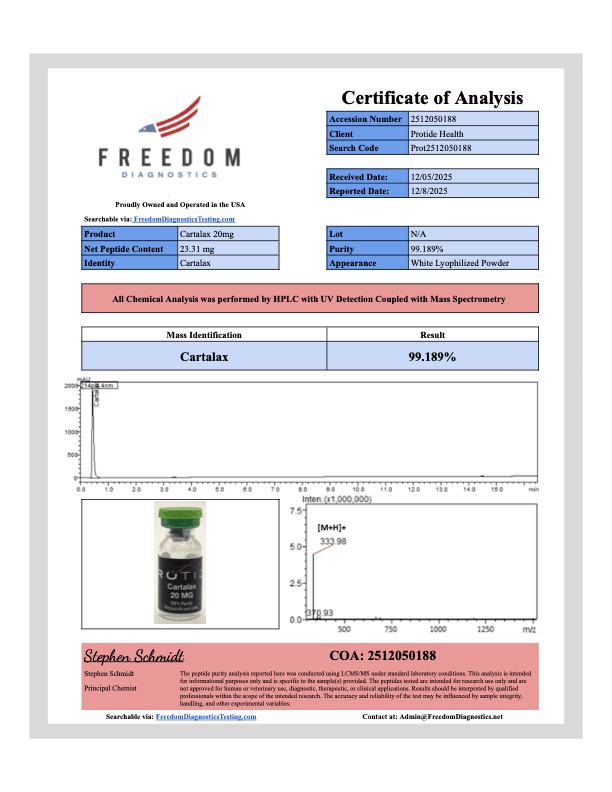
Cartalax (Ala-Glu-Asp) is a synthetic bioregulatory tripeptide investigated in preclinical fibroblast modulation, extracellular matrix (ECM) remodeling, and cellular senescence models. Supplied as a stable 20mg lyophilized vial. Third-party HPLC-verified >99% purity. For research use only. Not for human consumption.
Cartalax 20mg: A Synthetic Tripeptide for Cellular Senescence Research
Cartalax 20mg is a synthetic tripeptide composed of alanine, glutamic acid, and aspartic acid (Ala-Glu-Asp). In laboratory settings, this compound is investigated for its potential to modulate cellular aging processes and fibroblast function. Preclinical models commonly utilize this bioregulatory peptide to explore pathways linked to extracellular matrix (ECM) homeostasis and tissue regeneration models.
Exploring the Mechanisms of Cartalax
Laboratory investigations focus on how this synthetic peptide interacts with fibroblasts, the cells primarily responsible for producing the structural framework of tissues. Researchers study its mechanisms in strictly controlled environments to gather data on cellular proliferation and senescence.
Fibroblast Regulation Pathways
In vitro studies examine the compound’s ability to alter gene expression and cellular activity (PubMed). Preclinical models observe several specific mechanisms:
-
Upregulation of Ki-67 (a cellular proliferation marker) in fibroblast cultures.
-
Inhibition of matrix metalloproteinase-9 (MMP-9) synthesis, limiting ECM breakdown.
-
Reductions in caspase-dependent apoptosis and p53 expression during laboratory testing.
Research Applications in Preclinical Models
The primary role of this tripeptide centers on the regulation of tissue architecture and cellular aging. Scientists employ these compounds in animal models to yield data regarding regenerative biology and structural homeostasis.
Cartilage and Connective Tissue Studies
Animal studies measure the compound’s influence on biological markers of joint and tissue integrity. Preclinical models observe changes in chondrocyte-like cells following exposure (PubMed). Research investigates several endpoints:
-
Cellular proliferation rates within cartilage and connective tissue models.
-
Alterations in glycosaminoglycans and collagen production during in vitro testing.
-
ECM degradation rates linked to aging and tissue stress environments.
Dermatological and Renal Aging Models
Studies investigate the influence of the peptide on structural fibroblasts located in the skin and kidneys. Preclinical models measure markers of tissue remodeling to track biological changes (PubMed). Research examines:
-
Collagen and carnosine production variations in aged dermal cell cultures.
-
Alterations in senescence markers (p16, p21, p53) to study cellular longevity.
-
Apoptosis markers and cellular proliferation rates within renal aging models.
For specialized laboratory materials, investigators can explore the complete dermatological research category.
Peptide Characteristics
Concluding Thoughts on Cartalax
Cartalax serves as a vital instrument for investigating cellular senescence, fibroblast modulation, and tissue remodeling. Preclinical studies continue to examine its influence on ECM integrity, apoptosis reduction, and cellular longevity pathways.
References
-
Authors. “Khavinson Peptide Review.” PubMed. PubMed
-
Authors. “Cartalax Skin and Fibroblast Research.” PubMed. PubMed
Legal Disclaimer
The information provided in this description is for research purposes only. The Cartalax peptide is not approved by the U.S. Food and Drug Administration (FDA) or any regulatory authority for human consumption or therapeutic use. It is intended solely for investigational use in controlled laboratory settings by qualified researchers. Protide Health does not endorse or promote the use of Cartalax peptide in humans or animals outside of approved research protocols. Researchers must comply with all applicable local, state, and federal regulations, including obtaining necessary approvals for experimental use. Consult with regulatory authorities before initiating any research involving Cartalax peptide.
Products sold by Protide Health are for laboratory research purposes only and are not intended for human consumption, medical use, or veterinary use.
Be the first to review “Cartalax 20mg”
Related products

Cellular Longevity Research

Best Selling

Metabolic Research

Gastrointestinal Research

Cellular Longevity Research

Cellular Longevity Research

Gastrointestinal Research

Cellular Longevity Research
Reviews
There are no reviews yet.